



How To Reset Your Hyundai Airbag Module
The airbag system in your Hyundai is one of its most critical safety features, designed to protect you and your passengers in the event of a collision. When the Hyundai airbag module registers a fault, whether from a deployed bag, a sensor error, or a wiring issue, it stores that information and typically triggers a warning light on your dashboard. Resetting the module is sometimes necessary, but it is a process that deserves a careful, informed approach.
Understanding The Airbag Module
The airbag control module, sometimes called the SRS (Supplemental Restraint System) module, is the brain behind your vehicle's airbag deployment. It continuously monitors crash sensors, seat belt pretensioners, and occupant detection systems. When it detects an irregularity or records a deployment event, it locks that data and alerts you through the airbag warning light.
When A Reset May Be Needed
A reset is most commonly required after an airbag has deployed and the vehicle has been repaired. It may also be needed when a fault code has been stored due to a faulty sensor, a disconnected connector, or a battery issue that momentarily disrupted the system. In some cases, a new module may need to be programmed to the vehicle's specific configuration.
What The Reset Process Involves
Resetting the Hyundai airbag module is not as simple as disconnecting the battery and reconnecting it. While that step can clear some minor electronic faults, it will not erase a hard fault stored in the SRS module. A proper reset requires a professional-grade OBD-II scanner capable of accessing the airbag control system — not the basic code readers available at most auto parts stores.
The technician connects to the vehicle's diagnostic port, reads the stored fault codes, and determines whether the underlying issue has been properly resolved. Only then can the codes be cleared and the module reset. If the root cause has not been addressed, the light will return almost immediately.
The Risk Of Cutting Corners
Attempting to reset the airbag module without the right equipment or without fixing the actual problem puts you at risk. An airbag system with unresolved faults may not deploy correctly in a collision, or it could deploy unexpectedly. Neither outcome is acceptable. This is not a system where trial and error is appropriate.
Post-Deployment Considerations
After an airbag has deployed, the module itself may need to be replaced rather than simply reset. Many Hyundai models use single-deployment modules that lock permanently after an event and cannot be reliably cleared. A certified technician will be able to determine whether your module can be reset or whether a new one needs to be installed and programmed to your vehicle.
At Lakeland Hyundai, our certified technicians are trained to handle every aspect of your vehicle's safety systems with precision and care. As a 2026 Dealer of the Year and 2025 Board of Excellence Award recipient, we hold ourselves to the highest standards. Call our service department today and let us make sure your airbag system is functioning exactly as it should.
Lakeland Hyundai
Address
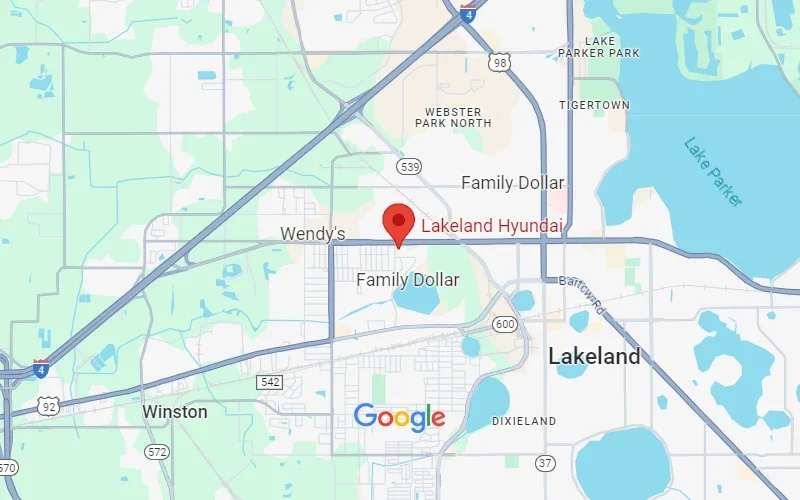
1500 West Memorial Blvd
Lakeland, FL 33815
Phone
- Sales 863-583-9200
- Service 863-583-9242
- Parts 863-686-5126
| Monday | 9:00AM - 8:00PM |
| Tuesday | 9:00AM - 8:00PM |
| Wednesday | 9:00AM - 8:00PM |
| Thursday | 9:00AM - 8:00PM |
| Friday | 9:00AM - 8:00PM |
| Saturday | 9:00AM - 8:00PM |
| Sunday | 12:00PM - 6:00PM |
| Monday | 7:30AM - 6:00PM |
| Tuesday | 7:30AM - 6:00PM |
| Wednesday | 7:30AM - 6:00PM |
| Thursday | 7:30AM - 6:00PM |
| Friday | 7:30AM - 6:00PM |
| Saturday | 8:00AM - 4:00PM |
| Sunday | Closed |
| Monday | 7:30AM - 6:00PM |
| Tuesday | 7:30AM - 6:00PM |
| Wednesday | 7:30AM - 6:00PM |
| Thursday | 7:30AM - 6:00PM |
| Friday | 7:30AM - 6:00PM |
| Saturday | 8:00AM - 4:00PM |
| Sunday | Closed |