



How To Identify Hyundai Premature Brake Disc Wear
Your Hyundai's braking system is one of the most safety-critical components on the vehicle, and the brake discs, also called rotors, sit at the center of it. While brake discs are expected to wear down over time, premature wear is a different story. It signals that something in the system is not working as it should, and catching a Hyundai brake disc wear issue early can protect both your safety and your wallet.
What Counts As Premature Wear
Brake discs on most passenger vehicles are designed to last anywhere from 30,000 to 70,000 miles, depending on driving habits and conditions. Premature wear refers to significant deterioration that occurs well before that range. If your discs are thinning, warping, or developing deep grooves within the first 20,000 miles or less, something is contributing to accelerated wear that needs to be identified. Driving habits play a meaningful role in how quickly brake discs wear down, and drivers who frequently brake hard from high speeds tend to see faster deterioration than those who brake gradually and anticipate stops.
Vibration Through The Brake Pedal Or Steering Wheel
One of the clearest signs of disc wear, particularly warping, is a pulsing or vibrating sensation through the brake pedal when you apply pressure. You may also feel this vibration through the steering wheel during braking, especially at highway speeds. This happens because a warped disc does not make consistent contact with the brake pad, causing uneven friction and that characteristic shudder. The vibration often becomes more pronounced as vehicle speed increases before braking, which can help distinguish it from other suspension-related vibrations that may occur independently of braking.
Squealing, Grinding, Or Scraping Sounds
Noise is one of the most reliable early indicators of brake issues. A high-pitched squeal during braking often comes from the wear indicators built into the brake pads, signaling that the pads are running thin and the discs may already be affected. A grinding or metal-on-metal scraping sound is more serious, typically meaning the pad material has worn through entirely and the metal backing plate is now contacting the disc directly, scoring its surface. Once metal-on-metal contact begins, the damage to the disc accumulates rapidly with every stop, often to the point where resurfacing is no longer an option and full replacement becomes necessary.
Visible Scoring And Groove Patterns
With the wheels on and a flashlight, you can often see the surface of the brake disc through the wheel spokes. A healthy disc will have a relatively smooth, even surface. Deep concentric grooves, heavy rust lines that do not clear after a few stops, or an uneven thickness across the disc face are all visual indicators of abnormal wear. A disc that appears significantly thinner toward the outer edge compared to the inner portion is also a concern. Some surface rust is normal after a vehicle has been sitting in wet conditions and typically wears off within the first few stops, but rust that persists across the full surface after regular driving suggests the disc may not be making full contact with the pad.
At Lakeland Hyundai, our factory-trained technicians are equipped to inspect your entire braking system thoroughly and make precise, honest recommendations. We stock genuine Hyundai brake components and offer service specials to help keep maintenance affordable. Schedule a service visit with us today because reliable braking is not something worth putting off.
Lakeland Hyundai
Address
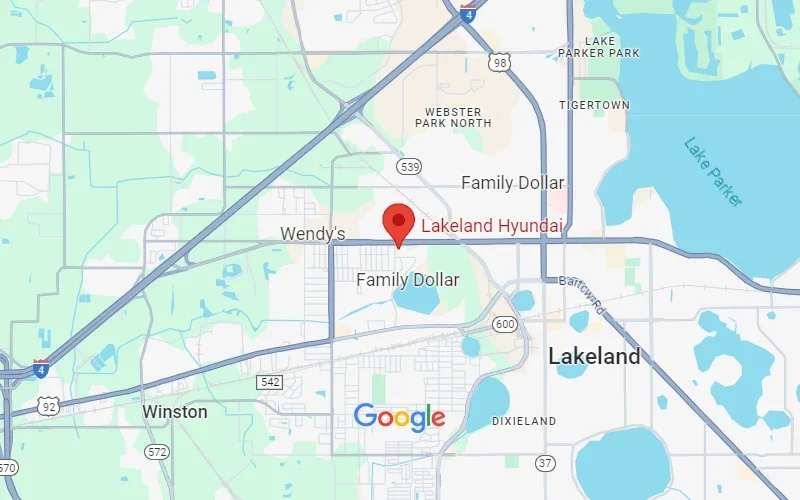
1500 West Memorial Blvd
Lakeland, FL 33815
Phone
- Sales 863-583-9200
- Service 863-583-9242
- Parts 863-686-5126
| Monday | 9:00AM - 8:00PM |
| Tuesday | 9:00AM - 8:00PM |
| Wednesday | 9:00AM - 8:00PM |
| Thursday | 9:00AM - 8:00PM |
| Friday | 9:00AM - 8:00PM |
| Saturday | 9:00AM - 8:00PM |
| Sunday | 12:00PM - 6:00PM |
| Monday | 7:30AM - 6:00PM |
| Tuesday | 7:30AM - 6:00PM |
| Wednesday | 7:30AM - 6:00PM |
| Thursday | 7:30AM - 6:00PM |
| Friday | 7:30AM - 6:00PM |
| Saturday | 8:00AM - 4:00PM |
| Sunday | Closed |
| Monday | 7:30AM - 6:00PM |
| Tuesday | 7:30AM - 6:00PM |
| Wednesday | 7:30AM - 6:00PM |
| Thursday | 7:30AM - 6:00PM |
| Friday | 7:30AM - 6:00PM |
| Saturday | 8:00AM - 4:00PM |
| Sunday | Closed |